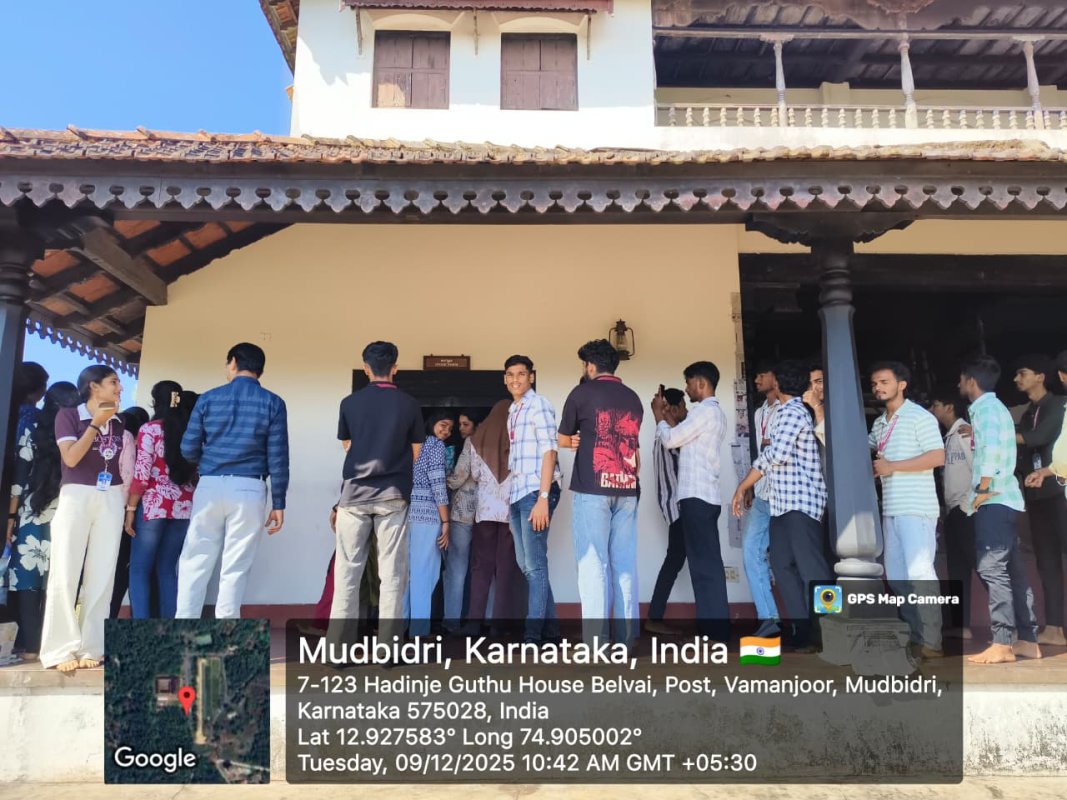
Enriching Cultural and Educational Visit to Pilikula Guttumane
On December 9, 2025, the Association of Information Science and Engineering (AISE), in collaboration with the Institution Innovation Council (IIC), organized an enriching cultural and educational visit to Pilikula Guttumane and the Artisan Village at Pilikula, Vamanjoor. The event was designed for the 3rd semester students of the Information Science and Engineering (IS&E) and Computer Science and Design (CSD) departments of Srinivas Institute of Technology (SIT), Mangaluru.
The visit focused on exploring how traditional knowledge and age-old practices can inspire research-driven and innovative approaches in modern applications. At Pilikula Guttumane, students gained valuable insights into the architecture and functional design of a traditional heritage house. They observed key elements such as the Daivada Mane (sacred space), traditional kitchen setups, ancient agricultural and household tools, and traditional grain storage methods. These features showcased eco-friendly construction principles and sustainable living practices that hold relevance for today’s design and engineering challenges.
At the Artisan Village, students witnessed live demonstrations of various indigenous crafts, including pottery making, oil extraction using bullock-driven mechanisms, bamboo craftwork, handloom weaving, traditional carpentry, and the preparation of beaten rice using manual tools. These demonstrations emphasized how local resources and sustainable techniques formed the backbone of traditional livelihoods, offering inspiration for environmentally responsible innovations in the present day.
The visit was made possible with the support of the Principal, Dr. Shrinivasa Mayya D.,. Additionally, Dr. Praveen Shenoy, IIC Coordinator, played a crucial role in aligning the event with the IIC’s vision of bridging industry and academia. and was successfully organized under the guidance of Prof. Sudarshan K., Head of IS&E. The event was coordinated by Prof. Sowmya, Staff Advisor of AISE.
This experiential learning opportunity enabled students to connect heritage practices with innovative problem-solving approaches. By studying these traditional methods, students were encouraged to conceptualize sustainable solutions that address contemporary global challenges, thereby fostering creativity, research orientation, and innovation-driven thinking.